
The Economics of the Fifa World Cup
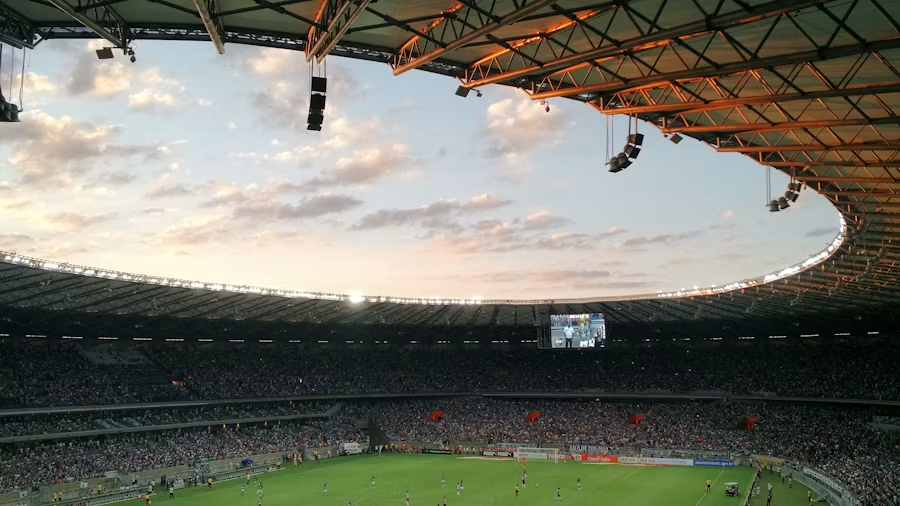
The World Cup presents itself as a competition between nations. Financially, it is closer to a four-week concentration of global intellectual property: a scarce live product, licensed across territories, surrounded by sponsors and sold at a premium because almost everyone is watching at once.
That distinction matters. The tournament’s economic value does not primarily come from the people inside the stadium. It comes from the billions outside it.
A media property in tournament form
FIFA generated $7.57bn during the 2019–22 commercial cycle. Broadcasting rights contributed $3.43bn, or 45% of the total. Marketing rights added $1.80bn, equivalent to 24%. Licensing generated another 10%, while hospitality and ticket sales contributed 13%.
In other words, television and sponsorship produced more than two-thirds of FIFA’s cycle revenue. Matchgoing supporters remain central to the atmosphere, but they are not the centre of the business model. The World Cup is monetised mainly through the right to distribute attention.
Qatar 2022 made the dependence especially visible. Rights connected to the tournament generated $6.31bn, representing 83% of FIFA’s revenue over the entire four-year cycle. Ticketing and hospitality produced $929m. That is a substantial sum; it is also far smaller than the value created by broadcasting, marketing and licensing the event worldwide.
This is why the World Cup behaves differently from a domestic club. A club monetises a recurring local audience across a season. FIFA monetises a rare global audience at extraordinary intensity every four years.
FIFA earns from the event; hosts invest around it
The usual claim that FIFA profits while hosts pay is directionally correct, but it needs precision. FIFA owns and sells the tournament’s commercial rights. Host governments and cities provide the public environment in which the event takes place: transport, security, urban services, fan zones and, where necessary, stadium upgrades.
Those expenditures are not all “World Cup costs” in an accounting sense. Some infrastructure would have been built anyway; some is accelerated or rebranded; some may generate value for decades. Equally, much of it never appears in FIFA’s financial statements. Comparing FIFA’s revenue with a host country’s entire infrastructure programme therefore mixes two different economic units.
The cleaner conclusion is structural. FIFA holds the scalable asset: the global rights. Hosts hold the location-specific obligations. The former can be sold repeatedly across markets; the latter must be delivered physically and often publicly.
Expansion creates more to sell
The format is part of the commercial architecture. The 2026 World Cup expanded from 32 to 48 teams and from 64 to 104 matches. That means more broadcast windows, more ticket inventory, more hospitality sessions and more opportunities for sponsors to activate around the tournament.
FIFA expected at least $11bn of revenue in the 2023–26 cycle, up from $7.57bn in 2019–22. The comparison is useful, but it is often misstated: $11bn is FIFA’s revenue across the full cycle, not the revenue of the World Cup alone. It also includes other competitions and commercial activities, including the expanded Club World Cup.
For 2027–30, FIFA has approved a $14bn cycle-revenue budget. Once again, the number describes the organisation’s four-year commercial system rather than one event. Still, the direction is clear. The World Cup remains the engine around which the rest of FIFA’s portfolio is built.
The scarcity premium
The World Cup’s economics are powerful because two forces coexist. It is enormous in reach and rare in frequency. Global audiences can follow domestic leagues every week, but the men’s World Cup offers a concentrated national spectacle that appears only once every four years.
That scarcity creates urgency. Broadcasters cannot replace it with another tournament. Sponsors cannot easily purchase an equivalent moment of shared attention. Host countries cannot manufacture the same symbolic status through an ordinary event.
The central strategic question is therefore not whether FIFA can sell more matches. It can. It is whether the organisation can expand supply without weakening the scarcity premium attached to each unit of content. The World Cup became a commercial giant by being global. It stayed exceptional by remaining rare.
Research Note | Interpretations and Assumptions
TSL interpretation: We describe the World Cup as primarily a media and intellectual-property business because broadcasting and marketing generated 69% of FIFA’s 2019–22 cycle revenue. This does not mean stadium income or host investment is unimportant; it means the most scalable value sits in globally distributed rights.
Sources and Methodology